
Introduction
Growth marketing is changing how modern entrepreneurs scale their companies. If your small business is struggling to turn traffic into paying customers, a standard marketing plan might not be enough.
Growth marketing uses data, experimentation, and full-funnel optimization to build sustainable, long-term revenue. In this guide, you will learn what growth marketing is, how it compares to other strategies, and practical ways to apply it to your business.
Quick Answer
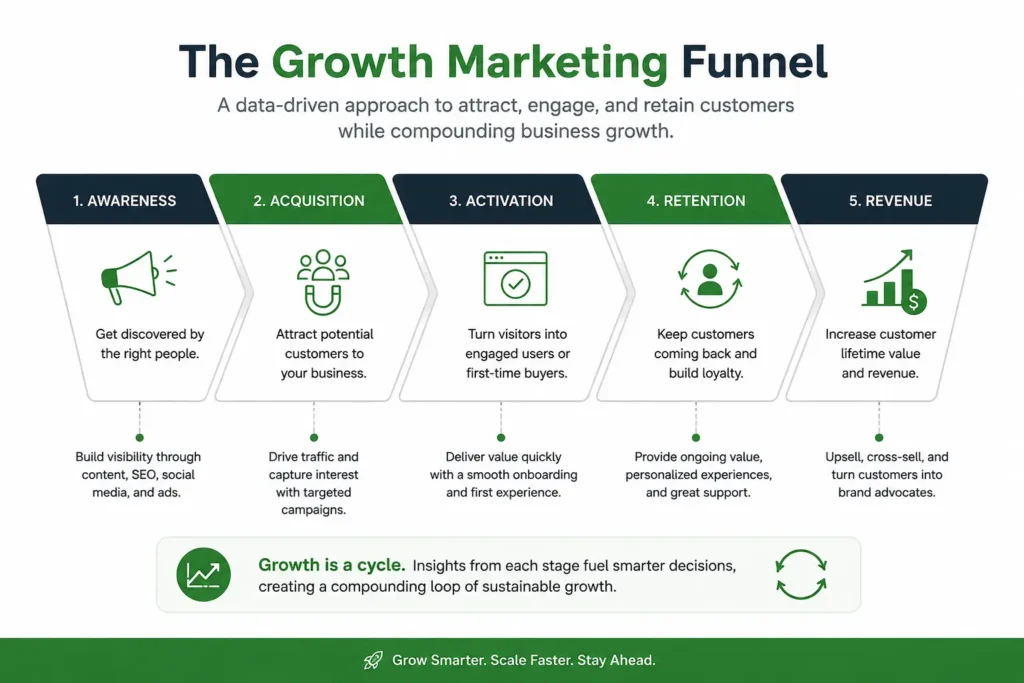
Growth marketing is a data-driven marketing approach focused on acquiring, activating, retaining, and growing customers using continuous experimentation. Unlike traditional marketing, it covers the entire customer journey rather than just initial lead generation.
What Is Growth Marketing?
Growth marketing is an iterative process of testing and optimizing every stage of the customer journey. It goes beyond simple brand awareness to look closely at customer retention and lifetime value.
Growth marketers run rapid experiments across channels to see what actually moves the needle. They rely heavily on analytics to make informed decisions rather than relying on guesswork.
Growth Marketing vs. Performance Marketing vs. Digital Marketing
It is easy to confuse growth marketing with performance marketing or general digital marketing. Understanding the differences helps you allocate your budget and team resources more effectively.
| Strategy | Primary Focus | Main Goal | Timeframe |
| Growth Marketing | Entire funnel & retention | Long-term sustainable growth | Medium to Long-term |
| Performance Marketing | Paid media & direct response | Immediate conversions & ROI | Short-term |
| Digital Marketing | Online channels & awareness | Brand visibility & traffic | Ongoing |
What Is Growth Marketing vs. Performance Marketing?
Performance marketing focuses heavily on paid channels to drive immediate, measurable actions. Growth marketing looks deeper into product experience, onboarding, and customer retention alongside paid acquisition.
What Is Growth Marketing vs. Digital Marketing?
Digital marketing uses online channels like social media, SEO, and email to build brand awareness. Growth marketing treats these channels as testing grounds to optimize the entire user journey from click to loyalty.
What Growth Marketers Do Every Day
Growth marketers act like scientists, constantly analyzing data and running split tests. They look for friction points where potential customers drop off and engineer solutions to fix them.
Daily tasks include analyzing user behavior dashboards, writing high-converting email sequences, and setting up A/B tests on landing pages. Their ultimate goal is to compound small efficiency gains into massive revenue growth.
Core Growth Marketing Strategies for Small Businesses
Implementing growth marketing does not require a massive enterprise budget. Small businesses can leverage agile tactics to punch above their weight class.
1. Optimize the Onboarding Experience
First impressions dictate whether a new user sticks around or abandons your product. Simplify your sign-up form and remove unnecessary friction to boost your activation rates.
2. Leverage Referral Programs
Turn your current happy customers into your most effective sales team. Offer tangible incentives for both the referrer and the new referee to encourage organic word-of-mouth growth.
3. Implement Content-Led Growth
Create hyper-specific resources that directly answer your target audience’s burning questions. This builds immediate trust and captures high-intent organic search traffic.
Real-World Growth Marketing Examples
Looking at successful campaigns helps clarify how these theoretical frameworks apply in practice. Real-world execution often relies on creative problem-solving and rapid testing.
- Dropbox: They designed a famous two-sided referral incentive that rewarded both existing and new users with extra storage space. This simple mechanism drove exponential viral growth.
- Hotjar: They used free-tier product offerings combined with viral branding loops to acquire thousands of small business users globally without heavy ad spend.
Essential Growth Marketing Tools
Having the right tech stack makes tracking experiments and user behavior much easier. Small businesses should start lean and scale their toolsets as revenue grows.
- Analytics: Google Analytics 4 or Mixpanel for tracking user behavior.
- Experimentation: Google Optimize alternatives or PostHog for running website tests.
- Email & Automation: ActiveCampaign or Mailchimp for automated lifecycle marketing.
Common Growth Marketing Mistakes to Avoid
Even experienced marketers fall into traps that stall their momentum. Avoiding these pitfalls saves both time and marketing budget.
- Scaling Too Fast: Pouring ad spend into a leaky funnel before optimizing user retention.
- Ignoring Qualitative Data: Relying solely on dashboard metrics instead of talking directly to your users.
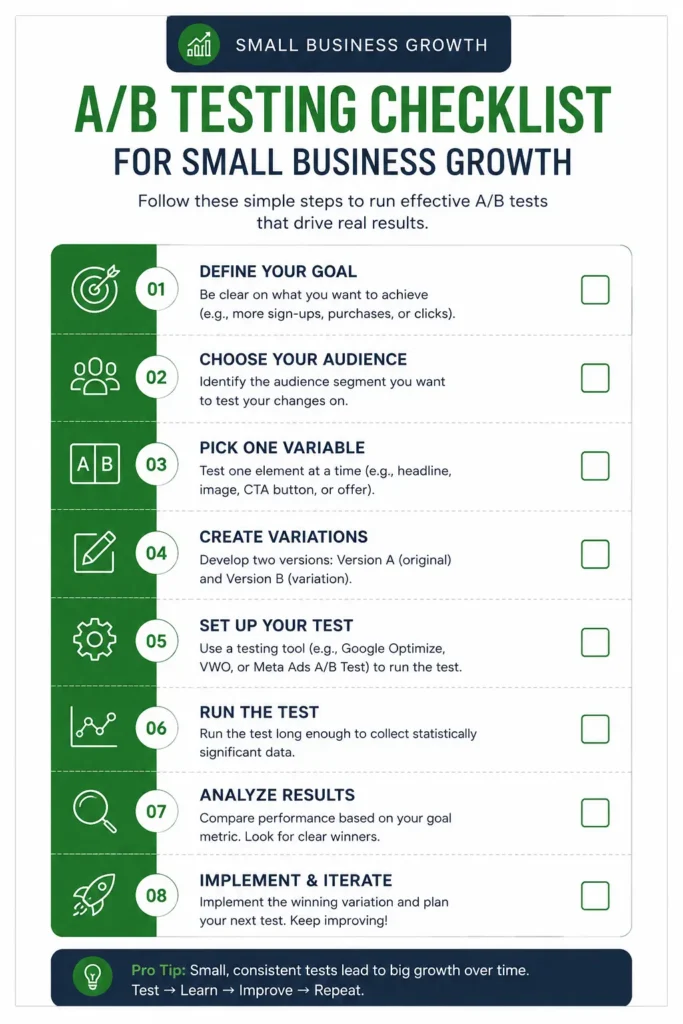
- Stopping Experiments Too Soon: Ending A/B tests before achieving statistical significance.
Frequently Asked Questions
What is growth marketing?
Growth marketing is a data-driven approach that optimizes the entire customer journey through rapid experimentation and retention focus.
How does growth marketing differ from traditional marketing?
Traditional marketing focuses mostly on top-of-funnel brand awareness, whereas growth marketing optimizes every stage including activation and retention.
Is growth marketing expensive for small businesses?
No, it relies heavily on organic loops, rapid testing, and data analysis, making it highly cost-effective for bootstrap budgets.
What tools do growth marketers use?
Common tools include web analytics platforms, A/B testing software, and customer lifecycle automation tools.
How long does it take to see results?
While performance marketing yields immediate clicks, growth marketing typically shows compounding results within 3 to 6 months.
Conclusion
Growth marketing gives small businesses the framework needed to scale efficiently in competitive markets. By shifting your focus from simple awareness to full-funnel optimization and retention, you create a compounding growth engine. Start by analyzing your current customer journey today and run your first small-scale experiment this week.
