

Introduction
Growth marketing is transforming how modern businesses attract, engage, and retain customers. If your company relies solely on traditional advertising to drive sales, you might be wasting budget on a leaky funnel.
What is growth marketing? It is a holistic, data-driven approach that optimizes every single stage of the customer journey. In this guide, you will learn core strategies, daily responsibilities, and essential skills needed to scale your business.
What Is Meant by Growth Marketing?
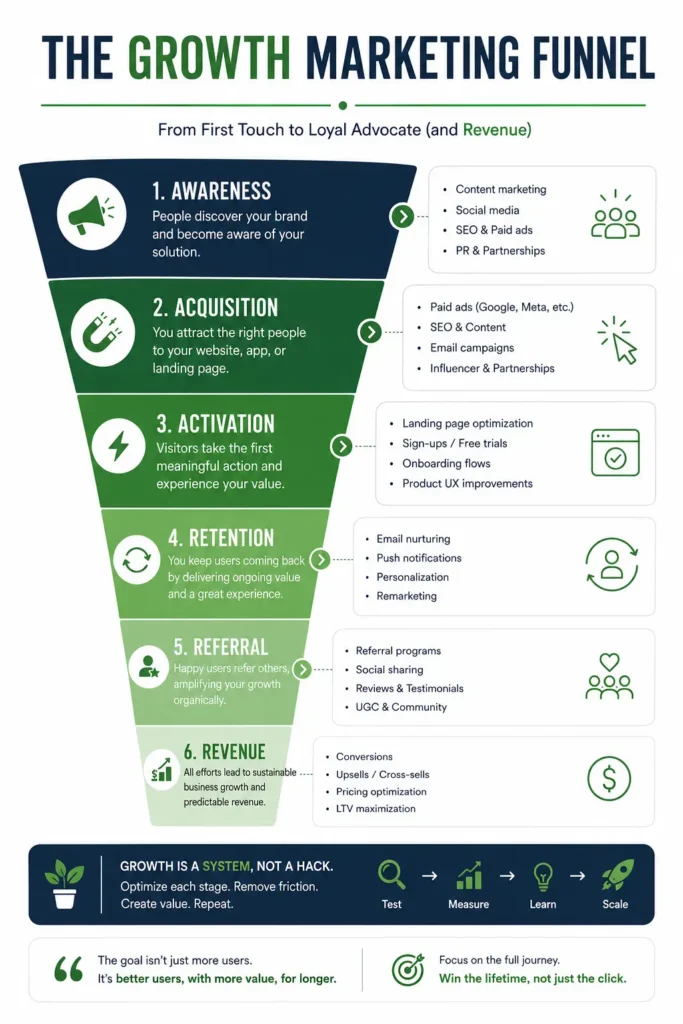
Growth marketing is an iterative process of continuous testing and optimization across the entire customer lifecycle. It goes beyond top-of-funnel brand awareness to prioritize activation, retention, and long-term customer value.
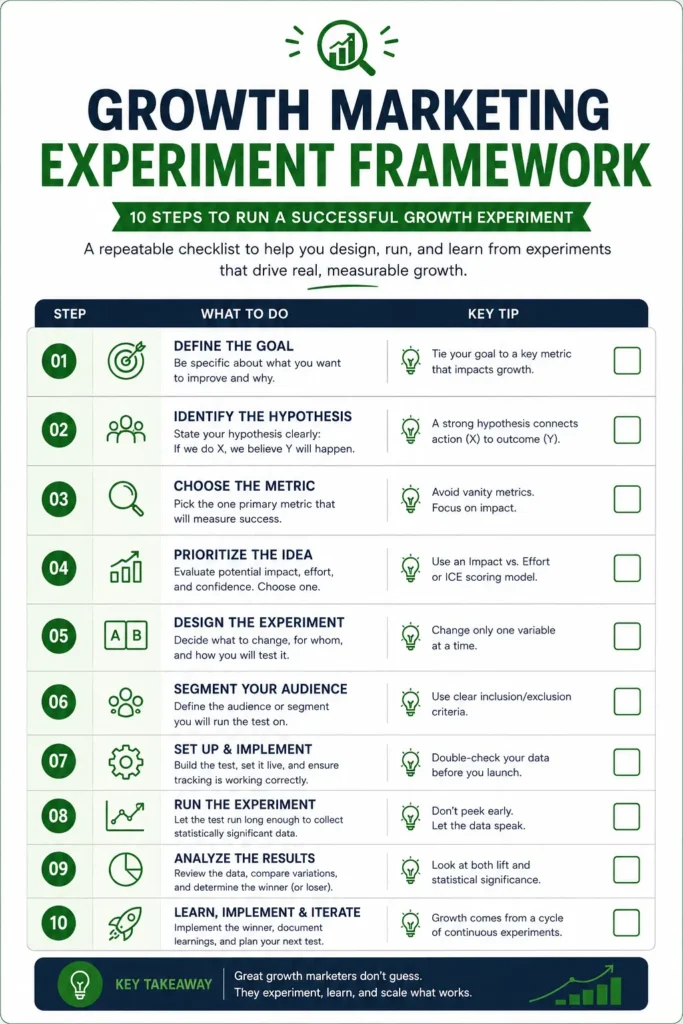
Growth marketers rely on data analytics rather than gut feeling to make strategic decisions. They run rapid experiments to discover what truly drives sustainable business expansion.
Quick Answer
What is growth marketing? It is a data-driven marketing methodology focused on acquiring, activating, retaining, and growing customers through continuous experimentation across the entire customer journey.
What Does a Growth Marketer Do?
Growth marketers act like scientists, constantly analyzing data dashboards and running split tests to eliminate friction. They look for drop-off points where users abandon products and engineer creative solutions.
Daily responsibilities include managing A/B tests on landing pages, building automated lifecycle email sequences, and analyzing user behavior. Their ultimate goal is to compound small efficiency gains into massive revenue growth.
Growth Marketing vs. Performance Marketing
It is easy to confuse growth marketing with performance marketing, but they serve different primary functions. Understanding the distinction helps you allocate marketing budgets more effectively.
| Strategy | Primary Focus | Main Goal | Timeframe |
| Growth Marketing | Entire funnel & retention | Sustainable long-term growth | Medium to Long-term |
| Performance Marketing | Paid media & direct response | Immediate conversions & ROI | Short-term |
Performance marketing focuses heavily on paid channels to drive immediate, measurable actions. Growth marketing looks deeper into product onboarding, user experience, and long-term retention alongside paid acquisition.
Growth Marketing Strategies
Implementing proven frameworks helps businesses scale efficiently without burning through capital. Small and mid-sized companies can leverage agile tactics to drive compounding results.
1. Optimize the User Onboarding Experience
First impressions dictate whether a new user sticks around or abandons your product forever. Simplify sign-up forms and remove friction to boost activation rates.
2. Implement Viral Referral Loops
Turn your current happy customers into your most effective acquisition channel. Offer tangible incentives for both the referrer and the new referee to encourage organic word-of-mouth growth.
3. Leverage Content-Led Growth
Create hyper-specific resources that directly answer your target audience’s burning questions. This builds immediate trust and captures high-intent organic search traffic.
Real-World Examples of Growth Marketing
Examining successful campaigns clarifies how these theoretical frameworks apply in practice. Real-world execution often relies on creative problem-solving and rapid loop iteration.
- Dropbox: They designed a famous two-sided referral incentive that rewarded both existing and new users with extra cloud storage space. This simple mechanism drove exponential viral growth.
- Spotify: They used personalized end-of-year data roundups to encourage massive social sharing and organic user acquisition.
Essential Growth Marketing Skills
Successful growth marketers combine analytical rigor with creative execution. Building a well-rounded skill set requires mastering both technical tools and human psychology.
- Data Analytics: Ability to interpret user behavior using tools like Google Analytics or Mixpanel.
- Experimentation Design: Skill in setting up statistically significant A/B tests and multivariate tests.
- Copywriting: Crafting clear, persuasive messages that drive user action across emails and landing pages.
- Basic UX/UI Understanding: Recognizing website friction points and suggesting layout improvements.
Frequently Asked Questions
What is meant by growth marketing?
Growth marketing is a data-driven approach that optimizes the entire customer journey through rapid experimentation and retention focus.
What does a growth marketer do?
A growth marketer analyzes user data, runs A/B tests, optimizes conversion rates, and builds loops to retain and grow customers.
What is the difference between growth marketing and performance marketing?
Performance marketing focuses primarily on paid media for immediate ROI, while growth marketing encompasses the entire funnel, including product onboarding and retention.
What are some examples of growth marketing?
Famous examples include Dropbox’s referral storage program and Spotify Wrapped’s social sharing loop.
What skills do growth marketers need?
Key skills include data analysis, A/B testing, copywriting, basic UX understanding, and funnel optimization.
How long does growth marketing take to work?
While performance marketing yields immediate clicks, growth marketing typically shows compounding results within 3 to 6 months.
Conclusion
Growth marketing gives modern businesses the structured framework needed to scale efficiently in competitive markets. By shifting focus from simple awareness to full-funnel optimization and retention, you create a compounding growth engine. Start by analyzing your current customer journey today and run your first small-scale experiment this week.
