
Introduction
Choosing the right marketing strategy can make or break your company’s expansion plans. If your team confuses top-of-funnel acquisition with long-term retention, you might burn through budget without seeing sustainable results.
What is growth marketing vs. performance marketing? While both rely heavily on data, they target different stages of the customer journey and operate on different timelines. In this guide, you will learn the exact differences and how to leverage both effectively.
What Is Growth Marketing vs. Performance Marketing?
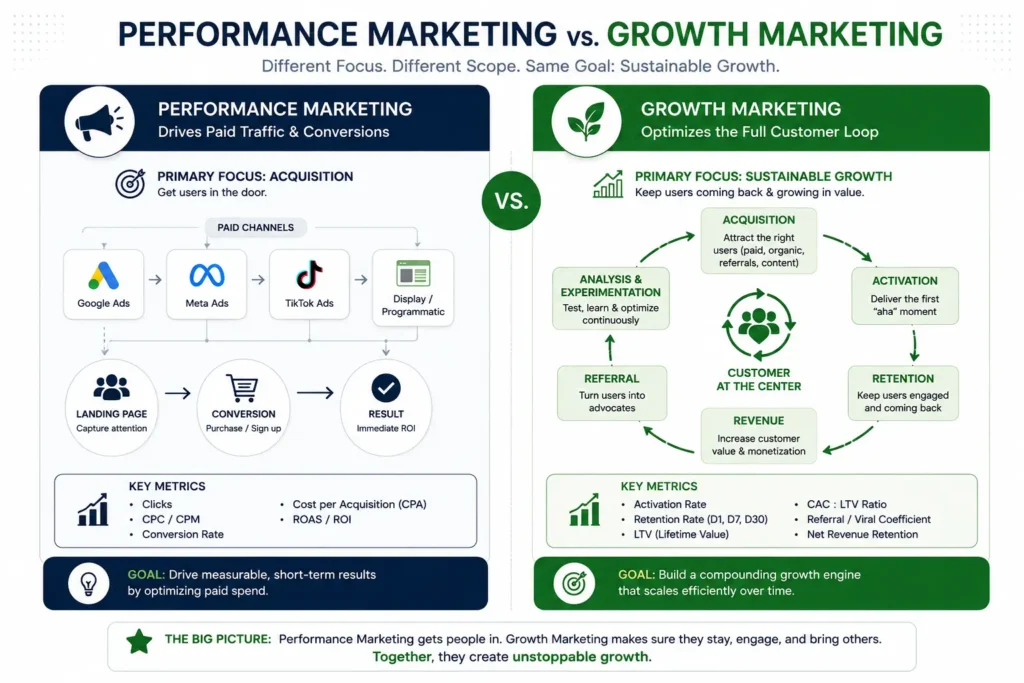
Growth marketing is a holistic, data-driven methodology focused on the entire customer lifecycle. It optimizes acquisition, activation, retention, and referral loops through continuous experimentation.
Performance marketing is a direct-response approach centered primarily on paid media channels. It measures success strictly through immediate, trackable actions like clicks, leads, or direct sales.
Quick Answer
Growth marketing vs. performance marketing comes down to scope and timeline. Growth marketing optimizes the entire customer journey for long-term retention, while performance marketing focuses heavily on paid media channels for immediate conversion results.
Core Differences Between Growth and Performance Marketing
Comparing their core pillars clarifies how each strategy impacts your bottom line and resource allocation.
| Feature | Growth Marketing | Performance Marketing |
| Primary Focus | Entire funnel (Awareness to Retention) | Bottom-of-funnel & Paid Media |
| Main Objective | Long-term sustainable compounding growth | Immediate conversions & low CAC |
| Time Horizon | Medium to long-term | Short-term |
| Key Channels | SEO, email, product loops, organic social | Paid search, paid social, display ads |
| Success Metric | Customer Lifetime Value (LTV) & Retention | Return on Ad Spend (ROAS) & Cost Per Lead |
What Is Performance Growth Marketing?
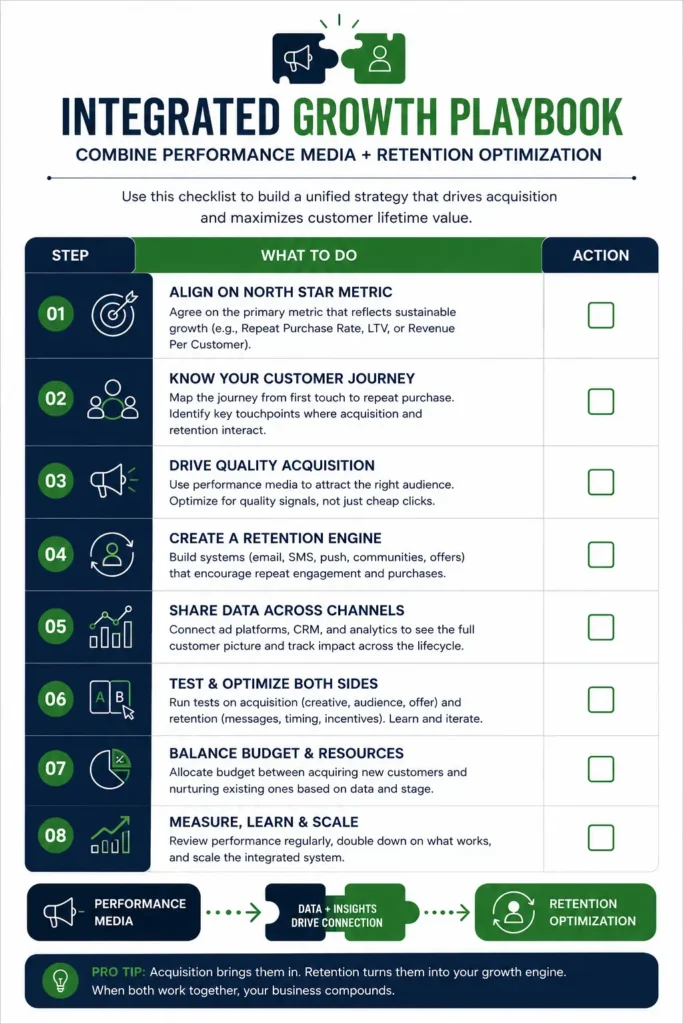
Performance growth marketing is an integrated approach that merges the two disciplines. It uses performance marketing’s rapid paid acquisition to feed data into a broader growth marketing funnel.
When to Use Performance Marketing
Performance marketing works best when you need immediate, predictable revenue and have a validated product-market fit. It allows you to scale acquisition quickly as long as your unit economics remain profitable.
1. Launching New Product Offers
When you need immediate feedback and quick conversions on a new launch, paid performance channels deliver rapid data.
2. Scaling Proven Funnels
If your conversion rates are stable and every dollar spent on ads reliably returns more in revenue, performance marketing helps you scale fast.
When to Use Growth Marketing
Growth marketing is essential when your business needs sustainable, long-term expansion without relying solely on escalating ad budgets. It fixes leaks in your product experience and maximizes customer lifetime value.
1. Improving Customer Retention
If you acquire users easily but struggle to keep them active after thirty days, growth marketing frameworks identify and solve the drop-off points.
2. Operating on Tight Budgets
When paid ad costs rise and margins shrink, growth marketing leverages organic referral loops and onboarding tweaks to drive cost-effective expansion.
Real-World Examples in Action
Seeing how companies blend or separate these strategies highlights their practical application in modern business.
- E-Commerce Brand: Uses performance marketing ads on Meta and Google for immediate customer acquisition, while deploying growth marketing email sequences to drive repeat purchases and loyalty.
- SaaS Startup: Relies on performance search ads to capture high-intent buyers, followed by rigorous product-led growth onboarding tweaks to boost free-to-paid conversion rates.
Frequently Asked Questions
What is growth marketing vs. performance marketing?
Growth marketing optimizes the entire customer journey for long-term retention, whereas performance marketing focuses primarily on paid media for immediate conversions.
What is performance growth marketing?
It is a hybrid strategy that combines paid media acquisition with full-funnel retention and lifecycle optimization.
Which is better for small businesses?
Small businesses often benefit from starting with growth marketing fundamentals and organic loops before scaling heavy paid performance budgets.
What metrics matter most in performance marketing?
Key metrics include Return on Ad Spend (ROAS), Cost Per Acquisition (CPA), and immediate conversion rates.
What metrics matter most in growth marketing?
Key metrics include Customer Lifetime Value (LTV), Churn Rate, Activation Rate, and Net Revenue Retention.
Can I use both strategies simultaneously?
Yes, combining them allows you to drive immediate paid traffic while systematically optimizing your product and retention loops.
Conclusion
Understanding the dynamic between growth marketing and performance marketing allows you to allocate resources efficiently. While performance marketing delivers immediate conversions, growth marketing builds the retention engines required for long-term survival. Audit your current marketing mix today and balance paid acquisition with full-funnel optimization.
